 Français
 Español
 English
 العربية
 Login
Login
 Donate















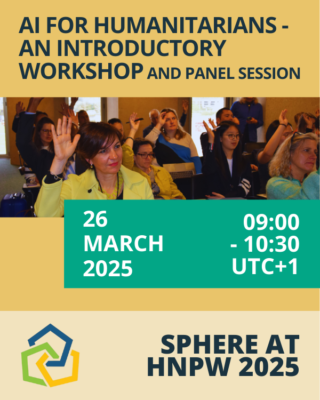
In a late 2024 survey, Sphere asked people working in the humanitarian sector what would be most beneficial to help them make good decisions about AI.
The top response across all organisations – supported by 64.4% of respondents – was training, which led Sphere onto an AI literacy training workstream.
The first key event was held in February in Nairobi: AI Literacy for Humanitarians, Nairobi, Kenya, 10 Feb 2025
Agenda
The first half (45 minutes) of this session was a panel session: Humanitarian AI Literacy, Fluency and Readiness. This was in hybrid format (in-person and online). Watch the recording here: https://www.youtube.com/watch?v=UYSQbZzb8gQ
The second half (45 minutes) was interactive and in-person only. We ran a practical activity taken from our AI Literacy for Humanitarians training package. In practice, we recommend this activity should be preceded by defining artificial intelligence. You should make distinctions between machine learning, deep learning, natural language processing, and generative AI, and cover related terms like training data, Large Language Model (LLM), etc.
To recreate the activity, split participants into groups and assign each group a different AI case study. Select ones relevant to your context/location if possible. For this session, we used four of the six provided in this document.
With reference to their case study, ask each group to answer the following questions (at least the first three – and the fourth if they have time):
- Advantages: What are the benefits of using AI in this way?
- Human involvement: At what point(s) should humans be involved?
- Stakeholders: What stakeholders are involved, or should be involved, in the project?
- Readiness: What capabilities would an organisation need before using AI in this way?
In the second part of the exercise, participants are asked to evaluate the risks of their AI use case with reference to humanitarian principles (humanity, neutrality, impartiality, independence, ‘do no harm’, the humanitarian imperative, etc.). AI may offer efficiency gains, but at what costs? The session is then debriefed.
Links from the Zoom chat
- AI nonprofit skills collection, Microsoft: https://learn.microsoft.com/en-us/collections/25zwhgt11p35rr
- Chapter 1 of AI fluency training from Microsoft hosted by HLA: https://hla.link/ai-fluency
- More info about the AI Safety Label project that Andrew referred to: http://sphere-backup.lndo.site/how-can-humanitarian-organisations-use-ai-safely/
- And the workshop in Nairobi that Andrew cofacilitated: http://sphere-backup.lndo.site/event/ai-literacy-for-humanitarians-nairobi-kenya-10-feb-2025/
- For more about the Community Engagement part of the AI safety label, check out this blog post from Nesta: https://www.nesta.org.uk/project-updates/how-to-manage-ai-risks-a-community-based-approach-to-ai-assurance/
- Event report from Nairobi event (with many more useful links in it): http://sphere-backup.lndo.site/wp-content/uploads/ai-workshop-nairobi-2025-event-report.pdf
- Free online course around ‘Community Crisis Intelligence’ developed by HLA, Nesta and others. Includes AI: https://kayaconnect.org/course/info.php?id=9112
- UKHIH/Nethope list of humanitarian AI use cases: https://www.ukhih.org/news/building-trust-with-ai-enhancing-transparency-and-information-sharing-for-humanitarians/
- AI competency framework for teachers from UNESCO: https://www.unesco.org/en/articles/ai-competency-framework-teachers
- And similar for students: https://www.unesco.org/en/articles/ai-competency-framework-students
Speakers
Panel Moderator
Ana Pinto de Oliveira
Ana is a Public Health Doctor and Professor of Global Health and Humanitarian Action at the Faculty of Medicine and Biomedical Sciences of the University of Algarve, Portugal. Since 2023, she has been a consultant for the WHO Vaccination Technical Group for the African region. She is currently an Independent Humanitarian Action Consultant in the field of health
Panellists:
Andrew Nzimbi
Andrew is an Independent Consultant with over 20 years of experience in the Humanitarian and Development Sectors, spanning multiple countries. He is keen on accountability to affected populations (AAP) and is a proponent of the use of people-centred approaches to develop evidence that is useful for supporting decision making. He is a humanitarian, researcher and trainer on AAP, Cash and Voucher Assistance and Humanitarian Standards.
Bernadette Sexton
Bernadette is the CEO of RedR UK. Her career spans development, good governance, institution building, tech for good, and human rights. She has held leadership roles including Chair at Concern Worldwide UK, CEO at Oxford Policy Management, in tech start-ups Moonshot CVE and Apolitical, and as international development programme lead at McKinsey. She holds an MBA, MSc in Public Service Policy & Management, and a BA in History and Politics.
Primo Amrein
Primo is the AI National Skills Director for Switzerland at Microsoft Philanthropies. In the past 19 years at Microsoft, Primo had different roles in Sales & Marketing, Team Leadership and Cloud Program Management. He previously worked for a strategy / management consultancy and a technology start-up. He holds a Technology Management Master of University St. Gallen and an international CEMS Certificate
James Maltby
James is an educator and creative technologist with over ten years’ experience as a senior digital manager and strategist within the non-profit sector. In his current role as Head of Digital Learning at Save the Children UK, he leads an award-winning team that creates online learning resources to improve the livelihoods of adults and children worldwide.
Workshop facilitator
Victoria Webbe
Victoria is a learning and development professional with experience in instructional design, facilitation, coaching, and knowledge management, including ten years in West and Central Africa. In her current role as Learning and Development Manager for RedR UK, Victoria is responsible for assuring the quality of RedR’s world class capacity strengthening programmes.
Event organiser: Tristan Hale