 Français
 Español
 English
 العربية
 Login
Login
 Donate














- Download the presentation
- Watch the webinar recording (English subtitles available)
Download the Sphere guide
(available in English, Arabic, French, Spanish and Portuguese)
Today, over half of the world’s population lives in urban areas. By 2050, an additional 2.5 billion people will be living in cities; the number of urban slum dwellers, currently close to one billion, is expected to double. These global changes are reflected in the Sphere Handbook 2018 edition, which explicitly includes references to urban settings for the first time. Yet, there is a belief that Sphere standards are mostly relevant or applicable in rural or camp settings.
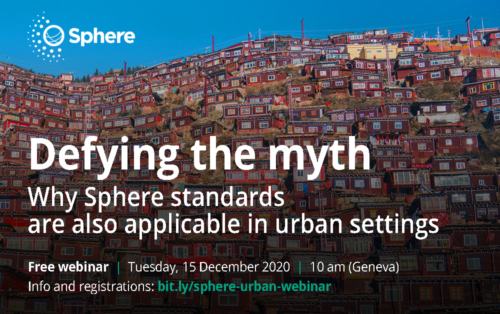
This webinar reiterated the standards as expressions of universal human rights – and therefore, always applicable. We discussed practical examples of local humanitarian actors using the standards in urban environments and presented Sphere’s newly released guide, “Using Sphere standards in urban settings“.
Speakers
- Dr Balwant Singh, Executive Director – Sphere (welcome message)
- Aninia Nadig, Policy and Practice Manager – Sphere (facilitator)
- Suman Ahsanul Islam, Director, Humanitarian Leadership Academy – Bangladesh
- Kamil Erdem Güler, Coordinator, Community-Based Migration Programmes – Turkish Red Crescent
- Prof. David Sanderson, Judith Neilson Chair in Architecture – University of New South Wales (Australia) and co-author of Sphere’s new guide on urban settings
- Zeynep M. Sanduvaç, Nirengi Association Board Member and Sphere trainer
- Dr Pamela Sitko, Senior Project Officer – Resilience NSW (Australia) and co-author of Sphere’s new guide on urban settings
Suggested reading
- David Sanderson and Pamela Sitko, Using the Sphere standards in urban settings (2nd edition) – Sphere, 2020.
- Understanding the operational context – Urban settings. The Sphere Handbook – Sphere, 2018.
- Pamela Sitko, “Humanitarian response is getting a major urban overhaul” – Citiscope, 2017.
- Ben Mountfield, Sphere for urban settings (1st edition) – Sphere, 2017.