 Français
 Español
 English
 العربية
 Login
Login
 Donate













About the Revision
-
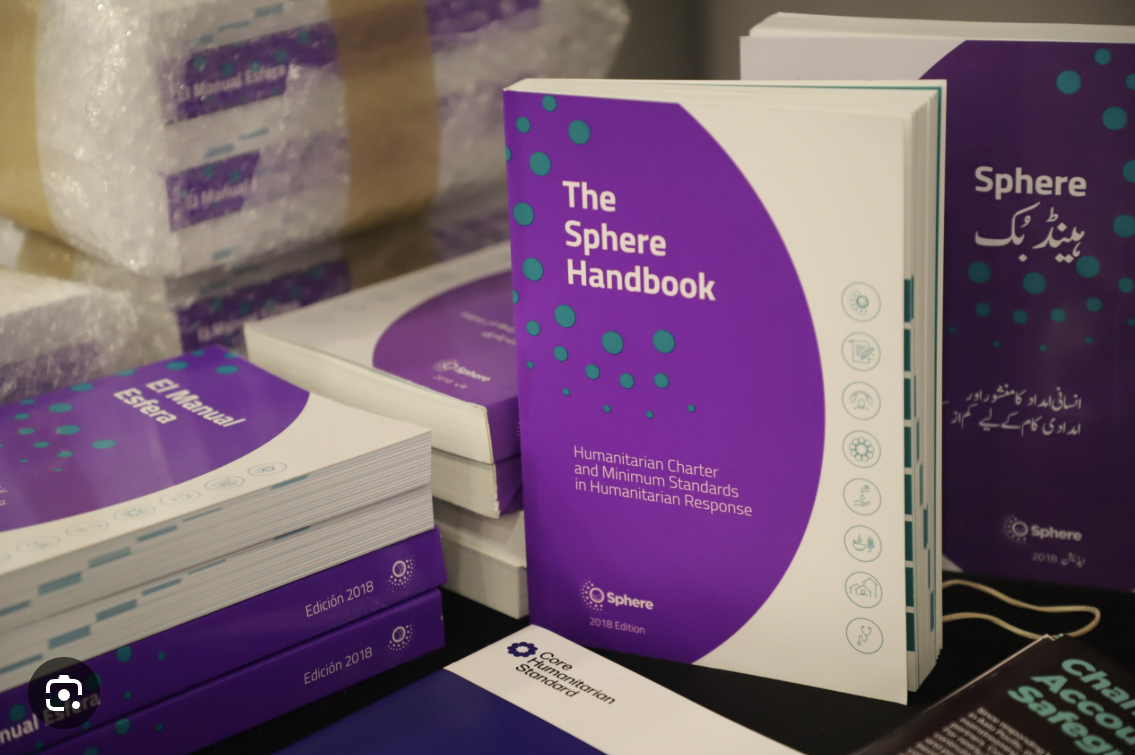
For nearly 30 years, the Sphere Handbook has helped shape humanitarian action around the world. It has become the common reference for quality and accountability, guiding countless organisations and individuals in protecting the dignity and rights of people affected by crisis.
Today, humanitarian action is changing faster than ever. Climate change, protracted conflicts, pandemics, new technologies, shifting power dynamics, and the growing leadership of local responders are transforming how humanitarian assistance is delivered. To remain trusted and fit for the future, the Sphere Handbook must evolve too.
This revision is more than an update. It is a unique opportunity for the global humanitarian community to shape the future of humanitarian standards. Over the next 2.5 years, humanitarian professionals, technical experts, communities affected by crisis, governments, UN agencies, NGOs, academics, and many others will come together to share evidence, challenge assumptions, and build consensus on what quality humanitarian action should look like in the years ahead.
Whether you work on the frontline, develop policy, conduct research, train others, or have lived experience of crisis, your knowledge matters. Join us in creating a Handbook that reflects the realities of today and inspires humanitarian action for tomorrow.
-
The revision is a 2.5-year process, with the revised Handbook expected to be published in Q4 2028.
The project is being delivered in three main phases:
- 2026 – Planning and Framework Development: Governance, revision methodology, stakeholder mapping, framework development, and pre-drafting consultations.
- 2027 – Drafting and Consultation: Content drafting, global consultations, technical review, validation, and integration of feedback.
- 2028 – Production and Launch: Finalisation of the Handbook, editorial production, translation, digital platform development, publication, and global launch.
Progress and key milestones will be shared on the revision website.
-
Yes. The current edition of the Sphere Handbook remains the official reference until the revised version is published in 2028.
-
The total budget for the Sphere Handbook revision is CHF 1.2 million. This includes in-kind and voluntary monetized time. Sphere has not raised this total amount but is working towards a fully resourced project. If this total is not possible, certain non-essential activities will be shelved. The revision is funded through a combination of financial and in-kind contributions from across the humanitarian community including local and international NGOs, UN agencies, the Swiss Government, private donors, and Sphere membership fees. We hope to engage support from traditional institutional donors.
Fundraising efforts are ongoing to support wider participation in consultations and ensure inclusive engagement opportunities across the global humanitarian community.
Who is involved and how decisions are made
-
The Sphere Handbook is written, updated and revised by the many for the many.
The revision is conducted through a structured process in which Technical Content Leads, Theme Leads, and Chapter Working Groups are responsible for drafting and revising content. Chapter Content Leads guide the development of individual chapters, while Theme Leads ensure cross-cutting issues (e.g. environment, technology) are consistently reflected across the Handbook. Working Groups contribute technical expertise, operational and community facing experience, peer review, and evidence-based input throughout the revision process.
Broader consultations will bring together humanitarian practitioners and frontline responders, technical experts, communities affected by crisis, academics, disaster management authorities, the private sector, military and civil defense actors, non-state armed groups, donors, and other stakeholders.
We acknowledge that invoking “evidence-based” guidance can quietly privilege: English-language evidence, peer-reviewed research, international agency reports, institutionally produced knowledge, Global North expertise. Therefore, we commit to making other forms of knowledge count in the standards decisions, including operational experience, local practice, community knowledge, Indigenous knowledge, lived crisis experience, non-English evidence, and evidence generated by local and national actors.
The revision process is led by the Revision Project Manager and Global Content Lead, with the Sphere Engagement and Operations teams and Executive Director providing strategic direction and operational support throughout. The process is managed under the strategic oversight of the Revision Steering Committee, with the final Handbook approved by the Sphere Governing Board.
This structure ensures that the Handbook reflects the collective expertise of the global humanitarian community while maintaining transparency and broad-based ownership.
-
Participation in the revision is based on an open expression of interest process designed to ensure transparency, inclusivity, and balanced representation.
Selection is guided by criteria that include technical expertise relevant to the thematic area, demonstrated operational experience in humanitarian contexts, organisational diversity across sectors, and geographic representation to ensure global perspectives are reflected.
Additional experts and under-represented voices may be brought into the process at any stage to respond to emerging needs, strengthen technical depth, or ensure contextual relevance throughout the revision.
-
All contributors must declare potential conflicts of interest. Governance procedures ensure transparency and balanced participation so that no single organisation, sector, or perspective dominates the revision process.
-
The revision follows a structured process with defined roles, published milestones, and regular updates shared on this website. Key stages and progress will be made publicly available throughout the revision.
How you can get involved
-
The revision belongs to the global humanitarian community, and there will be many ways to get involved over the next 2.5 years of the Handbook Revision.
Global engagement began in Q1 2026, with the official launch of the revision and a global call for Expressions of Interest (EoI). The humanitarian community responded with an incredible diversity of voices and expertise from around the world. While applications for the permanent Technical Working Groups have now closed, this is only the first phase of engagement. In Q3 2026, we will launch a call for experts to lead the cross-cutting themes. From Q4 2026 onwards, the revision will open to broader stakeholder engagement through consultations, workshops, surveys, technical reviews, and other activities.
Whether you’d like to participate in an upcoming local or online consultations, respond to a survey, attend a Sphere Focal Point webinar or event, or engage through your organisation, network, or community, every contribution helps shape the revised handbook. Every stage of the revision benefits from different voices, experiences, and expertise. By creating multiple ways to participate, we aim to ensure that everyone has a genuine opportunity to influence the future of the Sphere Handbook, ensuring it remains by humanitarians, for humanitarians.
We are developing a dedicated engagement hub, which will launch in Q3 2026, where individuals and organisations can register their interest, learn about upcoming engagement opportunities, and participate throughout the revision process. All engagement opportunities and updates will continue to be published on this website as they become available.
-
Yes. While English is the primary working language, all efforts will be made to provide translation, interpretation, and adapted consultation formats to support participation from diverse linguistic and regional contexts.
Language will not be a barrier to sharing your experience and expertise.
-
Participation is voluntary or in-kind. Selection is based on experience, expertise, and balanced representation, not funding availability. Participants are welcome to seek support from their own organisations or other funding sources to enable their participation, but this does not influence selection.
-
Updates, milestones, and participation opportunities will be shared on the Sphere Revision website throughout the revision process.
-
Broader stakeholder engagement will begin in Q4 2026, when opportunities, including information on how to organise or take part in consultations, workshops, surveys, and other engagement activities will be published on this website.
All engagement opportunities and updates will continue to be published on this website as they become available. For any other enquiries, you can contact: revision@spherestandards.org We aim to respond within 2–3 business days.
What the revision will deliver
-
Yes. The revised Handbook will be made available in multiple languages to support global accessibility and use.
-
The 5th edition adopts a digital-first approach, with an online platform as the primary, continuously updated resource. Printed Handbooks will always be available on demand either in full or bespoke sections.
The digital platform will provide structured, searchable access to all Humanitarian Standards Partnership (HSP) guidance with supporting tools, case studies, and guidance, and will support ongoing updates and practitioner contributions.
-
Supporting materials, including guidance and learning resources, will be developed to support understanding and practical application of the Sphere Handbook.
-
The Humanitarian Standards Partnership (HSP) brings together a set of complementary humanitarian standards and guidance handbooks. Together, they provide a common framework for quality and accountability while offering technical guidance for different sectors of humanitarian response.
The HSP guidance handbooks include:
- Sphere Handbook: The overarching humanitarian standards, including the Humanitarian Charter, Protection Principles, Core Humanitarian Standard, and technical standards for WASH, food security and nutrition, shelter and settlements, and health.
- Minimum Standards for Child Protection in Humanitarian Action: Standards and guidance for child protection programming in humanitarian settings.
- Minimum Standards for Education: Preparedness, Response, Recovery Standards for ensuring access to quality education during emergencies and recovery.
- Livestock Emergency Guidelines and Standards (LEGS): Guidance on protecting and supporting livestock-dependent livelihoods during crises.
- Standards for Supporting Crop-related Livelihoods in Emergencies (SEADS): minimum standards that support people responding to a humanitarian crisis to design, implement, and evaluate crop-related crisis responses.
- Minimum Standards for Market Analysis (MISMA): Standards for conducting market analysis to inform humanitarian programming.
- Minimum Economic Recovery Standards (MERS): Guidance on economic recovery, livelihoods, financial services and market systems in humanitarian contexts.
- Humanitarian Inclusion Standards for Older People and People with Disabilities (HIS): Standards to ensure humanitarian action is inclusive of older people and people with disabilities.
- Minimum Standards for Camp Management (MSCM):Standards for effective and accountable camp and site management in displacement settings. This handbook has been incorporated into the HSP’s interactive platform and is increasingly recognised as part of the partnership’s family of standards.
- Connectivity as Aid Standards (CAA): Minimum humanitarian standards for providing safe, inclusive, accountable and people-centred digital connectivity as a form of humanitarian assistance, recognising connectivity as an essential enabler of access to aid, information and services.
- Universal Logistics Standards (ULS): Minimum humanitarian standards for quality and accountability in humanitarian logistics and supply chain management, providing a common framework for planning and delivering procurement, transport, warehousing, distribution and fleet management.
The HSP is built on three shared foundations that underpin all of these handbooks:
- The Humanitarian Charter
- The Protection Principles
- The Core Humanitarian Standard (CHS)
Together, these resources provide the “why” (ethical and legal foundations), the “how” (quality and accountability), and the “what” (technical sector standards) of humanitarian action.

Stay informed
There will be opportunities to get involved in the revision over the next two years, including consultations and feedback processes, with most opportunities starting in January 2027.
Subscribe to the Sphere newsletter to receive updates about these opportunities and find out how you can get involved. Opportunities will also be announced on this website as they become available.
If you have any other questions, please email revision@spherestandards.org.