Towards efficiency and a new humanitarian paradigm: Sphere’s Q3 2025 roundup
Sphere • October 15, 2025
In the third quarter of 2025, Sphere continued to strengthen its impact and presence globally through training, partnerships, communication and advocacy.
Highlights included a new partnership to reduce duplication, a new tech grant, a new look for the Sphere website, and a new member of staff for the Sphere team.
As the humanitarian sector rapidly changes shape, Sphere is not only adapting in its own operations, but also creating new partnerships for sector-wide efficiency, and advocating for humanitarians everywhere to seize this opportunity for reform: The new humanitarian sector must work together with environmentalists and ecologists; and it must be community-centred rather than agency-centric.
The Sphere Handbook
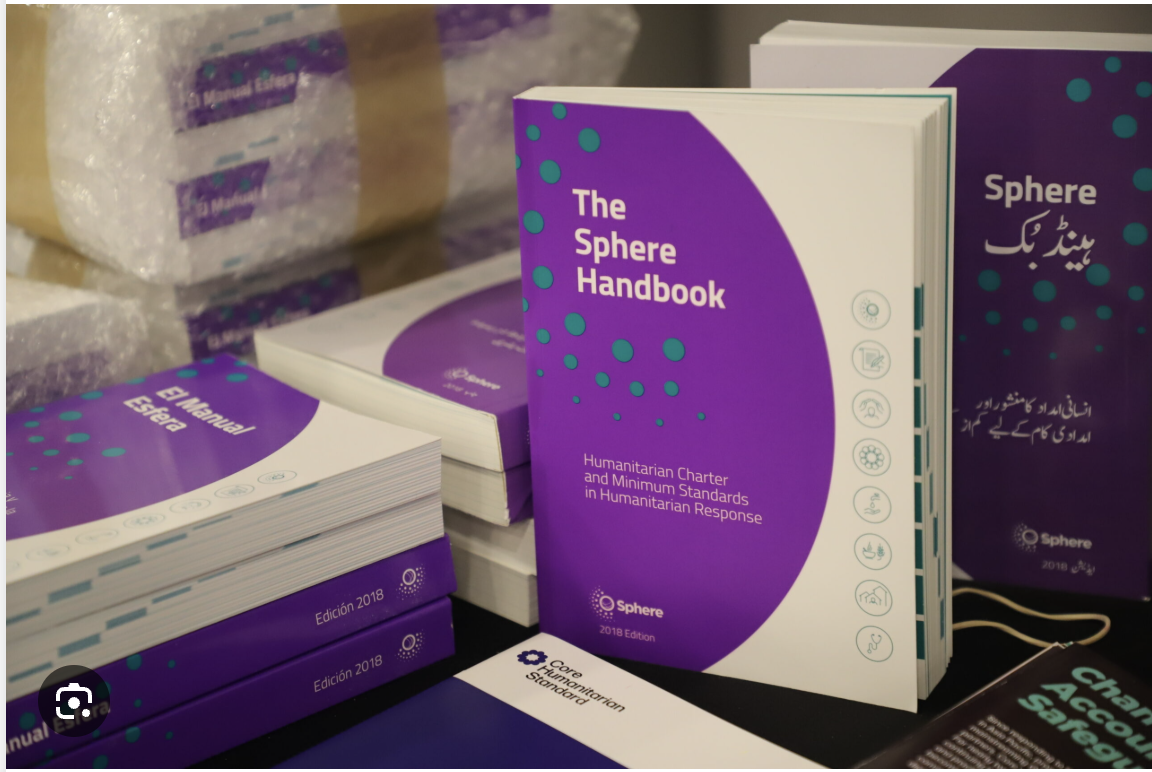
The Sphere Handbook – Humanitarian responders make informed decisions that reduce morbidity and mortality by applying its principles and minimum standards. The Sphere Handbook continues to serve as a shared reference that enhances accountability, efficiency, and coordination in humanitarian action.
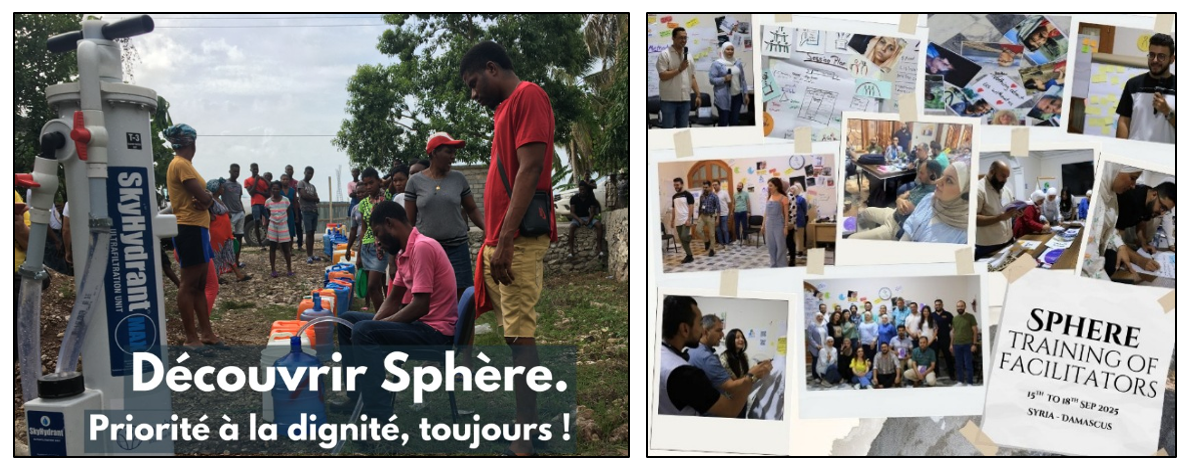
Sphere supported focal point for Brazil and Portugal, Fraternity – International Humanitarian Missions (FIHM) and Sphere trainer Aajhmana Cardoso, to deliver the French edition of the Dignity first, always! online workshop series – with a Spanish edition planned for later this year.
There were two Sphere Training of Trainers/Facilitators (ToT/F) events this quarter: 1) Ecuador, 6 to 12 July, with Sphere focal point Secretaría Nacional de Gestión de Riesgos (SNGR), facilitated by Sphere trainer Kevin Quelal, with the support of WFP; and 2) Damascus, Syria, 15 to 18 September, with Sphere focal point Arbeiter-Samariter-Bund (ASB), facilitated by Sphere trainers Hamza Hamwie and Axel Schmidt.
Discover Sphere: Dignity First, Always! | Training of Facilitators in Damascus
Strategic Partnerships
Strategic Partnerships – People responding to crises have streamlined access to humanitarian standards relevant to their context and stage of response. The Humanitarian Standards Partnership (HSP) is a leading authority on humanitarian standards.
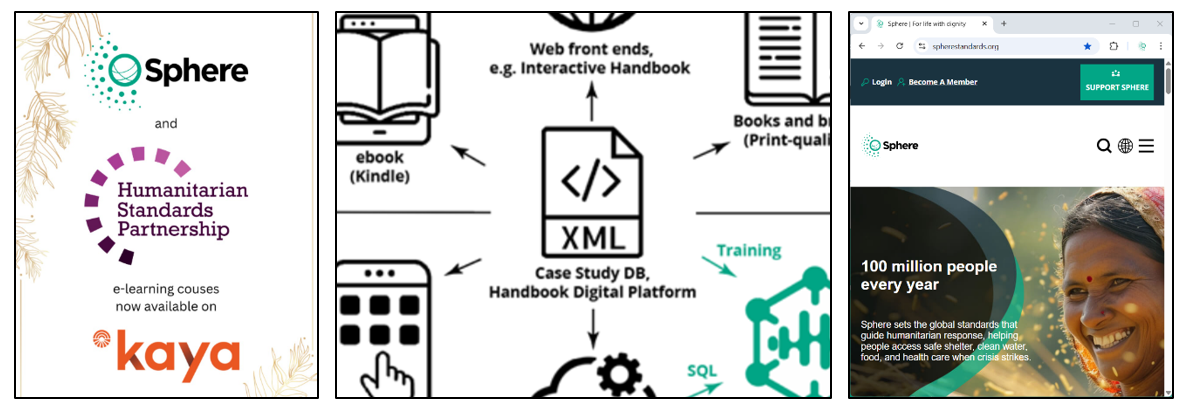
After 12 years of hosting a Learning Management System (LMS) – in which time over 75,000 people registered on the platform – Sphere transferred its online courses to Kaya; the LMS of the Humanitarian Leadership Academy (HLA). Read more about this new partnership between Sphere and HLA in Funding cuts, pivots and a call to collaborate more. Browse Sphere and HSP online courses available on Kaya here.
With the support of UK Humanitarian Innovation Hub (UKHIH), Sphere initiated a project to extend its innovative publishing and content management platform from the Humanitarian Standards Partnership (HSP) to the wider sector. By early next year, Elrha, the CCCM Cluster (Land and Shelter Cluster), and People-First Impact Method (P-FIM) will use the platform to manage and publish their WASH innovations, case studies, and voice-of-the-community reports, respectively. Read more in XML-first publishing: A smart approach to sharing humanitarian knowledge.
Sphere has grown from a recommendation in an assessment report in 1996[1] to a global movement and ubiquity in the humanitarian sector in 2025. Sphere’s growth and sustained presence is thanks to its voluntary network; enabled by a lean secretariat; funded initially by members and later joined by a few committed institutional (governmental) donors. As the sector evolves, Sphere is naturally leaning into partnerships with the private sector, academia, and foundations and other philanthropic organisations. Sphere’s new partnership pages represent part of new outreach activities – being careful to not move too far from the modest, community-led approach that is part of our DNA.
Sphere and HSP courses on Kaya | XML at the centre | New Sphere homepage
Policy & Advocacy
Policy & Advocacy – Sphere principles and standards are embedded into policies and operational frameworks at all levels, from local organisations to international institutions.
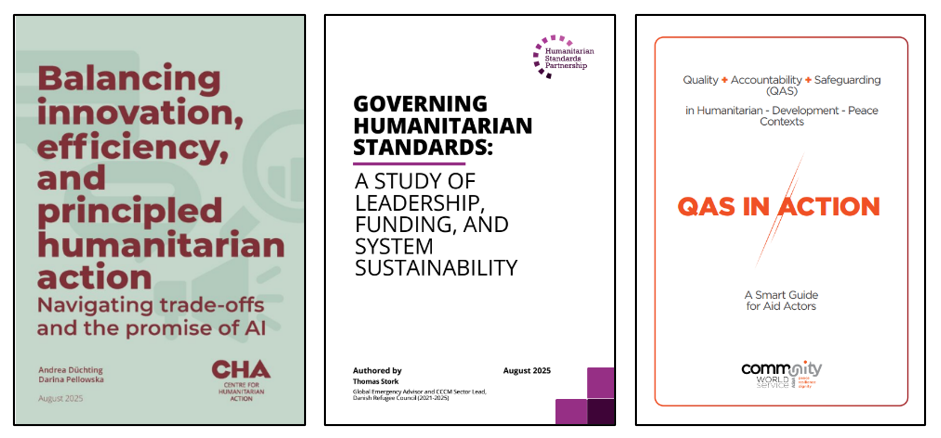
Sphere is grateful to the authors for their recognition of Sphere in the following documents published during Q3 2025.
Governing Humanitarian Standards[3] is an analysis of the governance, management, and funding of several sets of humanitarian standards, including Sphere, including recommendations for preserving these assets which “have become indispensable for effective humanitarian action”.
Sphere guidance including technical standards, the Core Humanitarian Standard, and Humanitarian Charter, along with HSP companion standards, are referred to extensively in QAS in Action: A Smart Guide for Aid Actors[4].
CHA report | Humanitarian standards report | QAS report
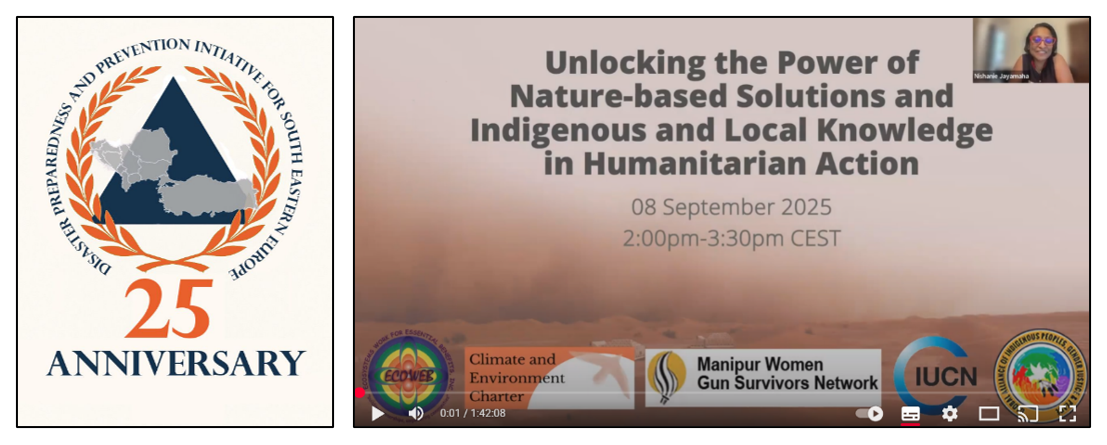
Sphere supported focal point representative for Bosnia and Herzegovina Haris Magrdzija to represent Sphere at the 50th Anniversary of Sphere regional partner for South-Eastern Europe DPPI-SEE (30 September and 1 October).
Tristan, Operations Director, presented Sphere during a brown-bag lunch with University of Geneva (UNIGE) Summer school students at the SDG Solutions Space in Geneva. William, Executive Director, represented Sphere at the UNHCR consultations; stepped up to co-chair the Learning Working Group of the Grand Bargain Community of Practice on Participation; and presented Sphere’s Nature-based Solutions (NbS) guide at Unlocking the Power of Nature-based Solutions and Indigenous and Local Knowledge in Humanitarian Action webinar (recording here).
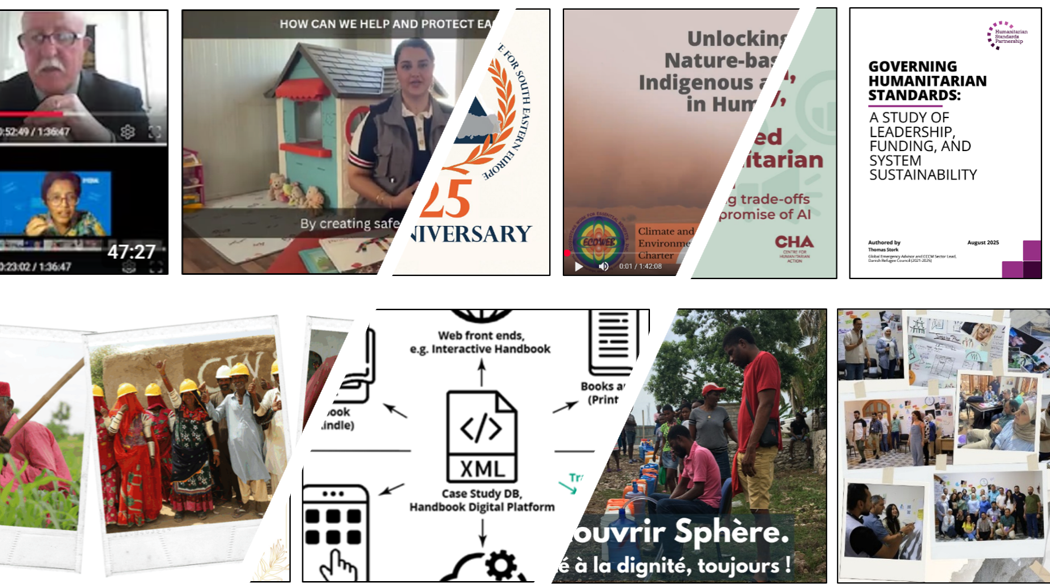
DPPI-SEE 25 years | NbS webinar
Champions Network
Champions Network – Sphere’s minimum standards are locally driven, strengthening national and community-based actors in their leadership and application of globally recognised humanitarian standards. This approach reinforces sustainability and enhances the effectiveness of humanitarian response.
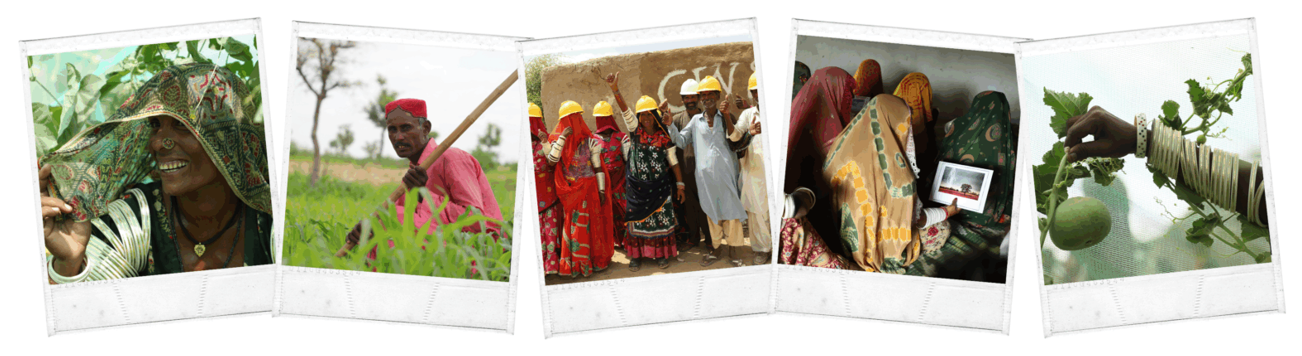
In August, Sphere Communications Manager Zunaira visited Umerkot, Pakistan, hosted by Sphere’s regional partner, Community World Service Asia (CWSA), to explore how standards are being applied in practice across different sectors. The visit included a school feeding initiative, disaster risk reduction (DRR) activities, and WASH interventions. These projects offered valuable insights into how Sphere Standards are translated into action on the ground, ensuring quality and accountability for affected communities. A detailed field diary captures experiences and lessons learned from Umerkot.
Photos from Umerkot
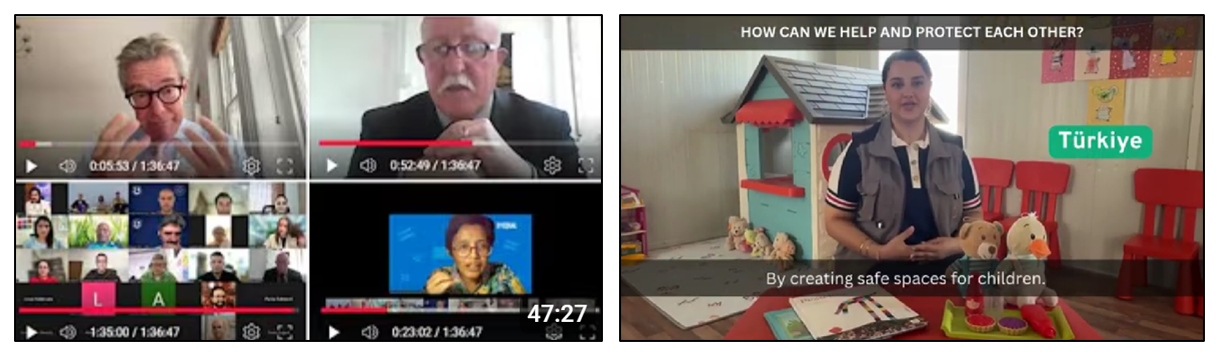
Sphere’s September online ‘Town Hall’ network meeting featured keynote presentations from Hugo Slim and Gerry McCarthy followed by questions and discussions. Hugo suggests four practical ways that we can be ecological humanitarians while Gerry shares the P-FIM approach for building mutual respect and trust with and between communities. Watch the 2-minute teaser or the full recording.
On 19 August, Sphere marked World Humanitarian Day by sharing a short video with our network, asking the question: “How can we protect each other?”. The reflections we received highlighted the spirit of solidarity and the collective responsibility that define humanitarian action. Watch how our network responded.
Town Hall | World Humanitarian Day
Communications
Sphere published seven posts and ran two email campaigns during the quarter:
A very warm welcome to Raquel Weintraub who has joined the global support team and is based in Mexico City. Sphere is grateful to CADENA and Aktion Deutschland Hilft (ADH) for enabling this appointment. As Network Manager, Raquel is the first point of contact for Sphere all Members and Focal Points. In her own words, Raquel says she:
“… believes in the power of community-led action, loves proposing new ideas and building meaningful collaborations. At Sphere, I get to work alongside incredible people and organisations who bring humanitarian standards to life. Let’s connect, collaborate, and keep strengthening this global network together.”
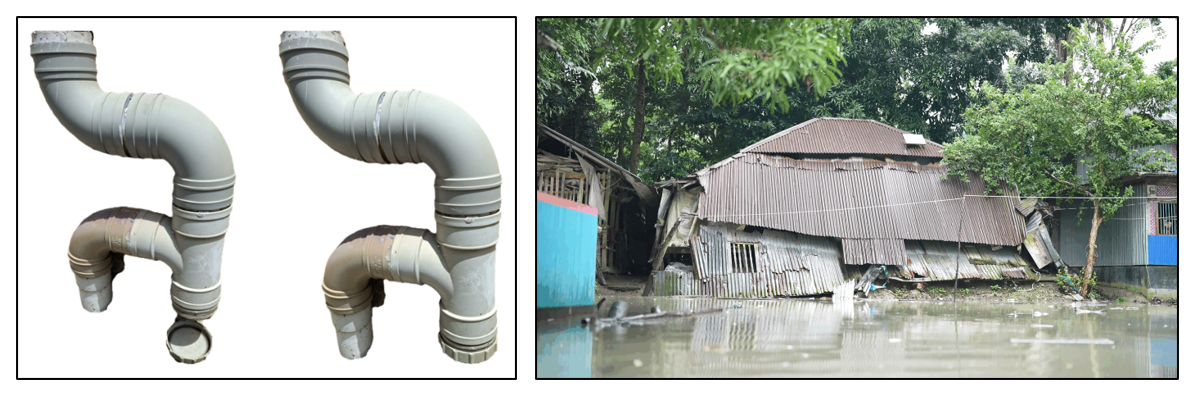
Jonas Habimana, Executive Director, Bureau d’Information, Formations, Echanges et Recherche pour le Développement (BIFERD) [caption id="attachment_56654" align="aligncenter" width="1024"] Local humanitarian…
 Français
 Español
 English
 العربية
 Login
Login
 Donate