Researching to what extent Sphere guidance informs humanitarian response: a first look
Sphere • October 21, 2025
Felicity Fallon, Director of Engagement
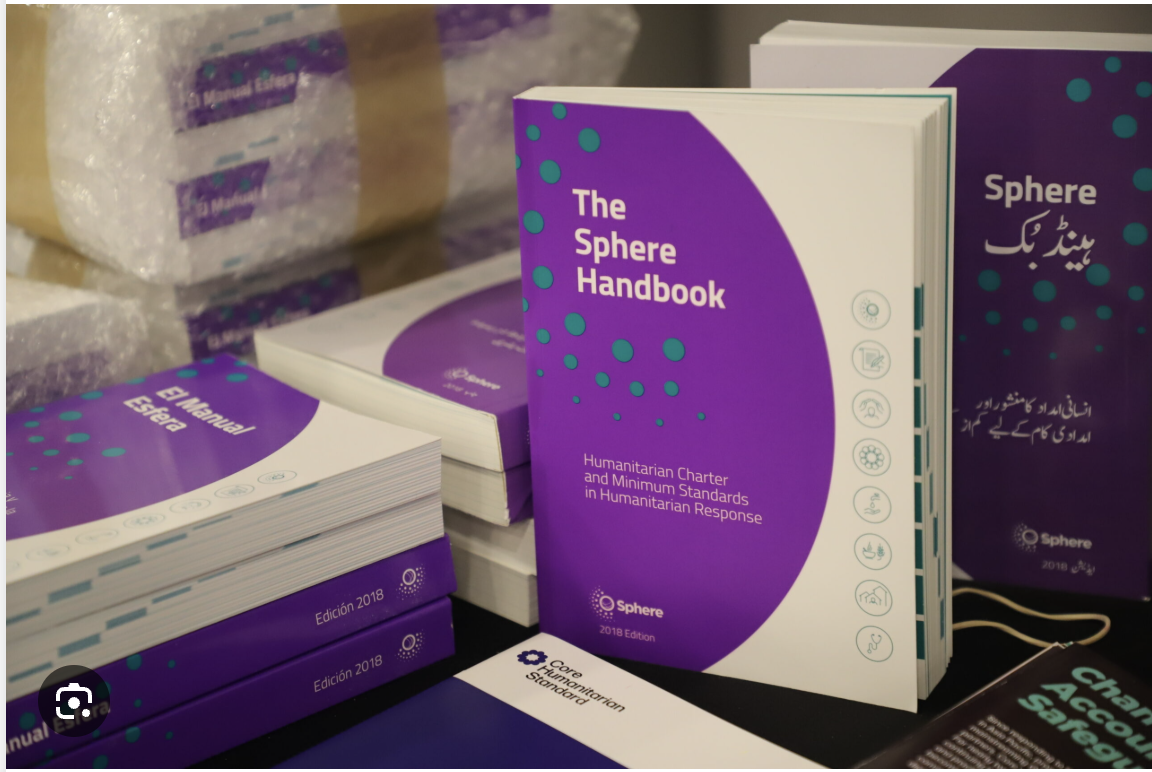
Since the first Sphere Handbook was published in 2000, Sphere has become the go-to resource for quality and accountability in humanitarian response. We are often asked to demonstrate the impact of the Sphere Handbook. This is a difficult task given Sphere’s ubiquity; open source ’public service’ model; and the many different applications of Sphere and ways of measuring its impact.
Methodology
As a first step, we asked our Summer 2025 intern to research what percentage of major humanitarian organisations align themselves with Sphere guidance. He took a sample of 39 humanitarian organisations to represent humanitarian UN agencies, the Red Cross and Red Crescent (RC/RC) Movement, and large international Non-Governmental Organisations (NGOs):
Members of the Steering Committee for Humanitarian Response (SCHR – which includes several large aid agencies)
Members of the Inter-Agency Standing Committee (IASC – which includes key UN agencies and NGOs)
Members of the UK Disasters Emergency Committee (DEC – 15 leading UK international aid charities).
This category of organisations is assumed to represent 92.5% of the sector, with revenue used as a proxy as this data is readily available*. Organisations in the other 7.5% were not included in the research, limiting any conclusions to 92.5%.
Findings
UN agencies
UNHCR incorporates Sphere across sectors in its Emergency Handbook. Sphere is used as the guiding framework for food security, shelter and camp management, health services staffing and psychosocial support.WFP embeds Sphere in its Emergency Field Operations Pocketbook, especially in food targeting, distribution, protection, and data collection. Its Protection & Accountability Handbook insists that partners adhere to Sphere’s Protection Principles.WHO and UNICEF use Sphere guidance for psychological first aid, mental health and noncommunicable diseases.IOM requires migrant centres to comply with Sphere standards and includes them as a key reference in their Camp Management Minimum Standards (CPMS), a Sphere companion guide.
INGOs and RC/RC movement
For programming
ActionAid cites Sphere’s Humanitarian Charter and Minimum Standards as an operational framework covering food aid, nutrition, shelter, water, sanitation, and health services. Action Against Hunger applies Sphere Protection Principles, while Concern International uses Sphere as a measure of quality within its Programme Cycle Management System. Similarly, CAFOD recommends the WASH chapter of the Sphere Handbook in its toolkit for integrated programme design, and CARE France includes adherence to Sphere standards in its field coordinator job description. IFRC, ICRC, and Plan International explicitly state their use of Sphere in programming, and MSF references Sphere indicators in its medical guidelines for water distribution. HelpAge International refers to Sphere and is co-author of the Humanitarian inclusion standards for older people and people with disabilities (HIS), a Sphere companion handbook.
Other uses
In addition to programming, INGOs use Sphere Standards in other aspects of their work such as funding, recruitment, and institutional alignment.ACT Alliance requires member organisations to apply Sphere and companion standards when designing and implementing projects funded by its Rapid Response Fund. Caritas Internationalis includes Sphere in staff training and organisational toolkits and considers it part of the core documents guiding international work. Sphere is referenced in the community feedback tools of the Danish Refugee Council and in monitoring and evaluation frameworks such as the IRC’s MEAL Handbook. Christian Aid highlights its Sphere membership in relation to donor-funded projects, while Islamic Relief and Tearfund align their internal quality standards with those promoted by Sphere. BRAC’s participation in revising the 2018 Handbook shows its engagement with shaping the standards themselves, while ICVA reaffirms member commitment to Sphere as part of broader sector principles.
Analysis
We found evidence that 35 of the 39 organisations in our sample (90%) use Sphere guidance to inform their humanitarian response. Based on these organisations being representative of 92.5% of the sector, we find that at least 83% of principled humanitarian action is guided by Sphere.Diverse applications of Sphere across organisations: Humanitarian organisations adopt Sphere Minimum standards in many ways, but always aligned around goals of quality, accountability, and ensuring that people affected by crisis can live with dignity.Sphere’s Minimum Standards guide assistance to 100+ million people affected by crisis each year: The UN and its partners reached 128 million people with some form of assistance in 2023**. 83% of 128 million is around 106 million. (In the same report, the UN estimates the number of people in need as 363 million.)
Limitations and further research
Figures presented in this article are estimates based on publicly available data and desk research. While they offer a useful snapshot of Sphere’s institutional reach, they do not capture the full complexity of humanitarian impact. For example, adoption of Sphere’s guidance by an organisation does not necessarily translate directly into improved outcomes for people affected by crises. Many factors, such as operational context, funding constraints, and security, affect how standards are applied in practice. Further research is needed to understand how the use of Sphere Standards affects the lives of crisis-affected people. Governments: This research does not account for national or local governments that have adopted or adapted Sphere standards in their disaster response frameworks or other guidance. Previous research conducted in 2016, 2019 and 2022*** identifies 29 countries where Sphere is mentioned in national disaster management guidelines from where it proliferates to national and local actors.IFRC: The International Federation of the Red Cross and Red Crescent Movements (IFRC) is a founding member of Sphere, and Sphere counts several national societies among the most active members and focal points in their network. However, further research should be conducted across the societies to see how adoption of Sphere varies.The big three: Given the dominance of UNHCR, WFP and UNICEF in the sector, further research is needed on the extent to which HQ commitments to Sphere standards influence field operations.All the other actors: Our analysis focused on major international agencies and did not include the thousands of community-based organisations, civil society groups, volunteer networks, local and national NGOs, or organisations outside the humanitarian sector, such as civil defence agencies, that actively use Sphere standards, many of whom are part of the broader Sphere community and play a critical role in humanitarian response.With thanks to John Kvernmo for contributing to this research.Todiscussthisresearch,ortohelpusextendit,pleasegetintouch @ felicity.fallon@spherestandards.org
FAO (Food and Agriculture Organization of the United Nations)
The Food Security Cluster (FSC) is jointly led by the FAO and the World Food Programme (WFP), coordinates food security responses during and after a humanitarian crisis, addressing issues of food availability, access, utilisation, and stability. The Sphere Handbook is a key resource for Food Security Cluster staff and partners working at country and global levels: https://fscluster.org/page/sphere-handbook.
IOM (International Organization for Migration)
Migrant Centres Management Toolkit : “Migrant centres shall comply at minimum with the Sphere standards, with the aim of ensuring quality and accountability of assistance and protection in line with humanitarian principles”: https://migrantcentres.iom.int/en/toolkit/management-migrant-centres/standards-assistance-and-minimum-requirementsCamp Management Minimum Standards: “Recognising that camps and other displacement settings are part of a larger ecosystem of humanitarian response, the Standards refer to existing guidance documents both in the CCCM technical sector, like the Camp Management Toolkit and the Handbook for the Protection of Internally Displaced Persons and core Humanitarian Standards Partnership resources, including The Sphere Handbook”: https://handbook.spherestandards.org/en/camp/#ch001
Policy and Procedures for Emergency Response “UNFPA adheres to key global humanitarian standards and principles and its work is guided by a human-rights based approach… Humanitarian Standards- The Sphere Humanitarian Charter and Minimum Standards in Humanitarian Response including both the Minimum Standards for Prevention & Response to Gender Based Violence in Emergencies and the Minimum Initial Service Package for reproductive health in crisis, as well other standards and guiding principles.”: https://www.unfpa.org/sites/default/files/admin-resource/PROG_Emergency_Response.pdf
UNICEF
I Support My Friends training manual references Sphere re Psychological first aid and Do No Harm approach: “Helping people in distress is something we do naturally, and is sometimes called psychological first aid (PFA). PFA is recommended by expert consensus as the ‘Do No Harm’ approach to helping people who have recently experienced a crisis event and are distressed”: https://www.unicef.org/media/102786/file/2.%20Training%20Manual.pdf
UNOCHA
“The Sphere Standards are the benchmark for ensuring humane and fair humanitarian assistance to people in need around the world. I hope that all organizations that provide humanitarian aid will become familiar with the standards and use them. This will improve the quality of humanitarian assistance to survivors of disasters and conflicts.” Baroness Amos, Valerie Amos, United Nations Under-Secretary-General and Emergency Relief Coordinator 2010-2015: Humanitarian consortium releases revamped industry standards – The Sphere Handbook 2011 | OCHAHumanitarian Needs and Response Plan (HNRP) template (draft 2025): “QUALITY. Humanitarian action must aim to meet and then exceed minimum quality standards (e.g. Sphere) as quickly as possible, ensuring assistance protects and upholds people’s dignity.”Indicators Registry: “The registry is a point of reference for country teams and clusters to seek standard definitions and guidance for indicators used at different stages of the Humanitarian Program Cycle…Many of the indicators in the registry include a short guidance in the column “description” and where applicable a reference to internationally agreed standards, in particular the Sphere Handbook (WASH, Nutrition, Food security, Shelter&NFI, Health), the CCCM Toolkit, INEE (Education), CP Minimum Standards (Child Protection), LEGS (Livestock) and MERS (Economic recovery)”: https://knowledge.base.unocha.org/wiki/pages/viewpageattachments.action?pageId=4015980547&preview=/4015980547/4015947779/Humanitarian-Indicators-Registry.xlsx
Emergency Field Operations Pocketbook: includes direct use of Sphere standards for food targeting, food distribution, Code of Conduct, and sample data collection sheet); “WFP and other UN agencies contributed to the development of the Sphere standards, many NGOs have signed up to them and some donors are making their funding of NGOs conditional on respect for the Sphere standards”: https://emergency.unhcr.org/sites/default/files/WFP%2C%20Emergency%20field%20operations%20pocketbook.pdfProtection and Accountability Handbook: “WFP’s approach to integrating protection is in line with the Sphere protection principles”, “All humanitarian actors, including WFP and its partners, must apply these principles in all humanitarian responses”: https://www.wfp.org/publications/2021-protection-and-accountability-handbook
WHO (World Health Organisation)
Operational manual on noncommunicable diseases in all-hazards emergency preparedness and response: “The Sphere handbook outlines the most widely accepted set of standards for the health response in humanitarian agencies. It includes standards for access to NCD preventive programmes, diagnostics and essential therapies for acute complications and long-term management of NCDs”: https://iris.who.int/bitstream/handle/10665/379892/9789240102187-eng.pdf
INGOs
ActionAid
The Rights-based Approach to Emergencies – A Beginner’s Guide: Cites Sphere: “The Sphere Project’s Humanitarian Charter sets out the following guiding principles:
The right to life with dignity. This covers laws on the right to life and freedom from cruel, inhuman or degrading treatment.
A distinction between combatants and non-combatants. Non-combatants are protected under humanitarian law.
Non-refoulement. Under refugee law, no refugee should be sent back to a country where his or her life or freedom may be threatened due to race, religion, or nationality etc.
The Sphere Project’s Minimum Standards provide an operational framework for ensuring that people affected by disasters have access to the minimum requirements in the following five core areas: food aid, nutrition, shelter and site planning, water supply and sanitation, health services”: https://actionaid.org/sites/default/files/rba_approach_guide.pdf
Humanitarian Operations Manual: “ACT Alliance humanitarian operations should adhere to and reflect Sphere Guidance and Standards. The foundations of the Sphere Handbook are the Humanitarian Charter, Protection Principles and the CHS. These lay out the key principles, responsibilities, and duties of humanitarian actors and are to be adhered to at all times”: https://actalliance.org/wp-content/uploads/2025/01/Quality-Standards.pdfIn order to be eligible for their Rapid Response Fund organisations must apply Sphere standards: “Requesting members are required to apply the Core Humanitarian Standard and Sphere and companion standards in the design and implementation of RRFs”: https://actalliance.org/wp-content/uploads/2025/06/Rapid-Response-Fund-Guidance.pdf
Acknowledges its membership of Sphere: “We regularly run projects on behalf of governmental and other major donors, including UK Aid and the European Commission, and are active members of 30 networks promoting excellence in the delivery of humanitarian and development programmes, including…Sphere”: https://www.christianaid.org.uk/our-work/what-we-do/how-we-operate
Age Inclusive Disaster Risk Reduction – A Toolkit: “Humanitarian Inclusion Standards for Older People and People with Disabilities developed by ADCAP are a companion standard of the Sphere standards. They offer guidance to ensure older persons and persons with disabilities are included in humanitarian response; they consider their capacities and needs and affirm their rights to access, safety and dignity in humanitarian response”: https://www.helpage.org/silo/files/ageinclusive-disaster-risk-reduction-a-toolkit.pdf
International Council of Voluntary Agencies (ICVA)
Reaffirmation of principles and standards, including Sphere: “The General Assembly hereby reaffirms the commitment of its members to a set of principles and standards essential for principled and effective humanitarian response…ICVA will support its members to uphold these humanitarian principles and standards by providing training and resources on humanitarian principles and standards; facilitating dialogue and collaboration among humanitarian actors; and advocating for the implementation of humanitarian principles and standards”: https://www.icvanetwork.org/uploads/2024/02/Reaffirmation-Principles_ICVAGAMarch-2024_EN.pdf
International Federation of Red Cross and International Committee of the Red Cross (IFRC and ICRC)
Founding member of Sphere. The Code of Conduct for the International Red Cross and Red Crescent Movement and NGOs in Disaster Relief is in the Sphere Handbook.“The IFRC’s Minimum standards for protection, gender and inclusion in emergencies programming provides key guidance for National Societies. The Protection Principles in the Sphere Handbook and The Minimum Inter-Agency Standards for Protection Mainstreaming also provide widely accepted guidance on protection mainstreaming”: https://www.icrc.org/sites/default/files/document_new/file_list/mpf_english.pdfTurkish Red Crescent Annual Report 2024: “Turkish Red Crescent aims to spread the Sphere Standards, one of the internationally accepted common principles and universal minimum standards that are the most known in humanitarian aid operations”: https://www.kizilay.org.tr/Upload/Dokuman/Dosya/annual_report_2024-10-07-2025-62753989.pdf
Islamic Relief was first certified against the Core Humanitarian Standard (CHS) in 2017. “Our recertification reaffirms our accountability to the communities we serve and our commitment to transparency and to ensuring our work is carried out to the highest standard. Some aspects of the CHS values overlap with Islamic Relief’s own five values that guide everything we do: ikhlas (sincerity), ihsan (excellence), rahma (compassion), adl (social justice) and amana (custodianship). The recertification also confirms that we are managing our resources effectively and designing programmes that create a positive impact when responding to crises and supporting communities”: Everything you need to know about the Core Humanitarian Standard – Islamic Relief Worldwide
The Cash Transfer Implementation Toolkit: “What a household requires to meet basic needs —on a regular or seasonal basis —and its average cost over time. “Basic needs” are defined by affected households themselves, International Humanitarian Law, and Sphere Standards”: https://www.mercycorps.org/sites/default/files/2019-11/CashTransferImplementationGuide.pdf
Oxfam Denmark: “Through international humanitarian law, principles, and standards, we are committed to acting when people’s lives, health, and livelihoods are at risk…Oxfam Denmark is committed to upholding the Humanitarian Charter and Minimum Standards for Humanitarian Response (Sphere): https://oxfam.dk/en/about-us/responsibility-and-quality-assurance/Oxfam Hongkong: “Oxfam actively promotes international standards for humanitarian response in mainland China”: https://www.oxfam.org.hk/en/what-we-do/development-programmes/mainland-china/oxfam-actively-promotes-international-standards-for-humanitarian-response-in-mainland-china
“In humanitarian responses, we follow the Core Humanitarian Standard on Quality and Accountability (CHS), internationally recognised standards which place communities and people affected by crisis at the centre of humanitarian action, and guide our emergency response work. It is a voluntary and measurable standard.”: https://www.savethechildren.net/about-us/accountabilitySphere Shelter, WASH, Food and Nutrition, Health standard indicators referenced in Save the Children “Indicator Guidance: Humanitarian, Development and Advocacy”: https://indicators.savethechildren.net/
Tearfund
Includes Sphere in the quality standards the organization aligns with: “As well as setting high standards for ourselves in our Quality Standards, we have signed up to a range of internationally recognised operating codes and standards because they reflect our principles of respecting the people we work with”: https://learn.tearfund.org/en/how-we-work/our-standards
****Desk research found references to Sphere guidance in 35 out of the 39 organisations studied.Reference to Sphere guidance was not found in 3 organisations: UNDP, UN–Habitat and OHCHR.
Jonas Habimana, Executive Director, Bureau d’Information, Formations, Echanges et Recherche pour le Développement (BIFERD) [caption id="attachment_56654" align="aligncenter" width="1024"] Local humanitarian…
 Français
 Español
 English
 العربية
 Login
Login
 Donate