Français
 Español
 English
 العربية
 Login
Login
 Donate












Summary
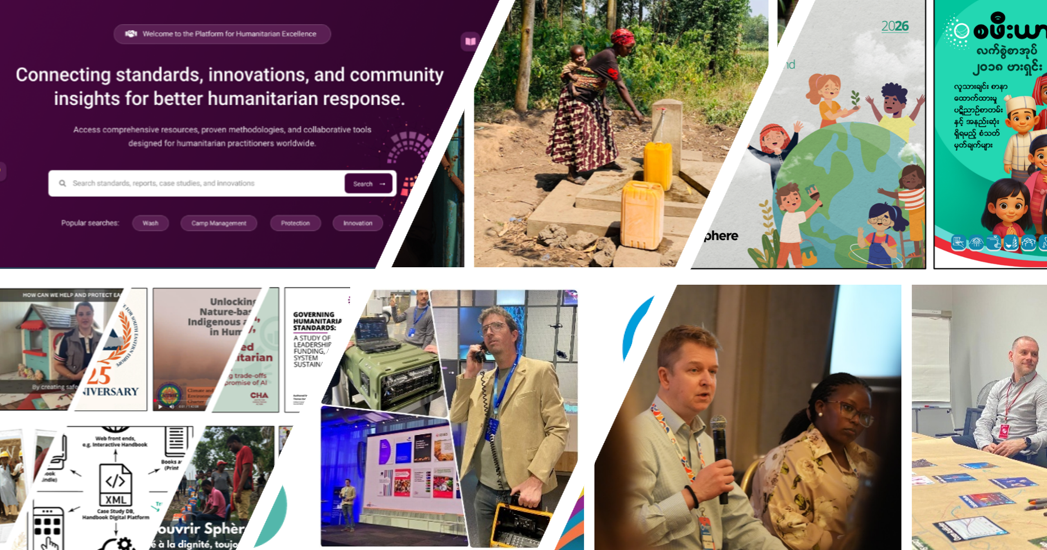
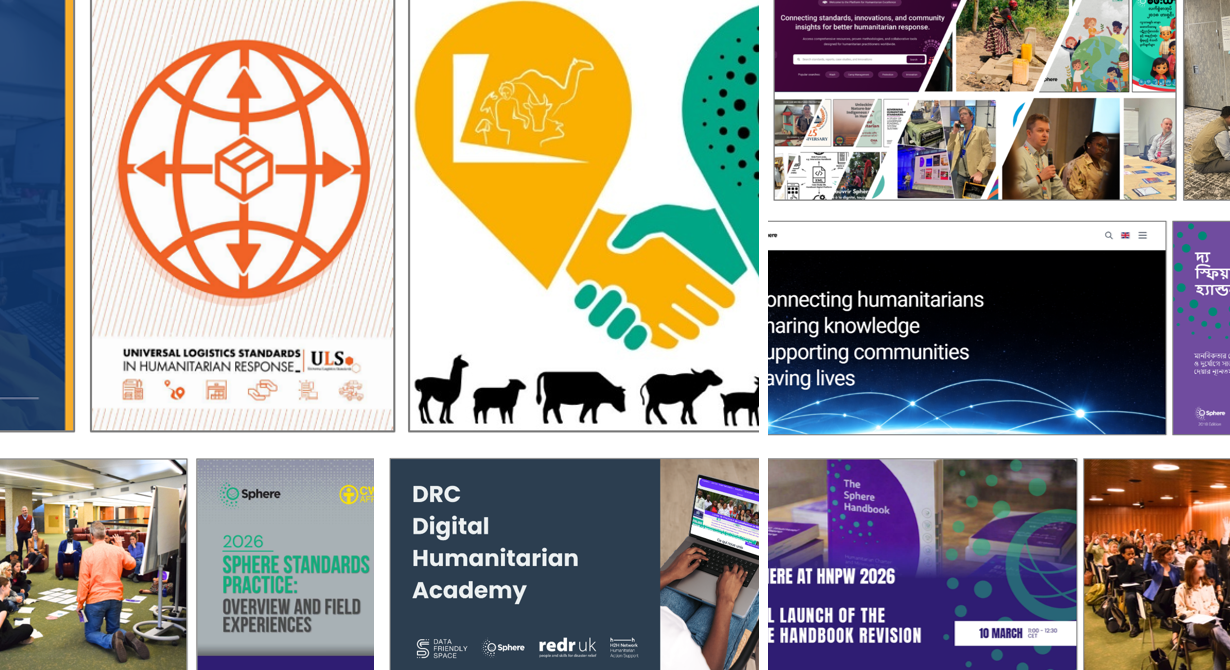
The Humanitarian Networks and Partnerships Weeks (HNPW) event is a perennial highlight in the first quarter of each year – but this one was notable as Sphere officially launched the Handbook revision process alongside special guest Dominik Stillhart, Head of Swiss Humanitarian Aid (SHA) and Deputy Director General at Swiss Development Cooperation (SDC).
This quarter also marked the start of the Sphere Strategy 2026–2028, setting the organisation’s direction for the next three years.
While organisations large and small across the humanitarian sector continue to explore various shared services initiatives, Livestock Emergency Guidelines and Standards (LEGS) and Sphere took the practical step of signing a new agreement which is already providing a positive example of how humanitarian organisations can work more closely together.
Almost eight years after adopting digital publishing approaches for the first time, Sphere, in partnership with Elrha, completed a significant upgrade to its shared end-to-end accessible publishing platform and content management system (CMS), including a new front end.
Sphere – in partnership with Data Friendly Space (DFS), RedR, CONAFOHD, BIFERD and GHDCI, and supported by H2H Network – started a new project to co-create the Democratic Republic of Congo Humanitarian Training Academy.
As the Sphere Handbook revision picked up pace, the team was kept busy analysing over 1,000 job applications and conducting dozens of interviews for several positions. Sphere is grateful to everyone that applied, and looks forward to welcoming several new colleagues in Q2.
Sphere Strategy 2026–2028
The Sphere Strategy 2026–2028 reaffirms the Humanitarian Charter and sets a clear, practical roadmap for the next three years. In a time of profound global change, it underscores Sphere’s continued commitment to quality, accountability, and dignity as non-negotiable principles of humanitarian action.
Grounded in broad consultation with nearly one hundred stakeholders across the humanitarian system, the strategy reflects a shared commitment to strengthening principled action in crisis response.
Over the coming years, Sphere will focus on delivering the Sphere Handbook revision, strengthening and expanding its global network, amplifying its policy influence, and building durable strategic partnerships to enhance sustainability and impact.

The Sphere Handbook
The Sphere Handbook – Humanitarian responders make informed decisions that reduce morbidity and mortality by applying its principles and minimum standards. The Sphere Handbook continues to serve as a shared reference that enhances accountability, efficiency, and coordination in humanitarian action.
- Behind the scenes, Sphere has been preparing for the Sphere Handbook revision for several months; not intensively, but steadily putting foundations in place, including securing the resources required to get started. During this quarter, Sphere moved up a gear with the following revision-related activities.
- Official launch of the Sphere Handbook revision process at Humanitarian Networks and Partnership Weeks (HNPW). The well-attended event – both in-person and online – started with some words from Dominik Stillhart, Head of Swiss Humanitarian Aid and Deputy Director General at Swiss Development Cooperation (SDC):
“The Sphere Standards, for me, define what is good enough in humanitarian work and humanitarian action. They are important because they provide what I think is a common language across all organisations and contexts – and they provide a benchmark for training, for evaluations, and for accountability”
- New Revision page on the Sphere website. We’ll be keeping this page up to date with the latest important information regarding the revision – most importantly, how you can get involved. Right now, we invite you sign up to join a chapter or thematic working group based on your experience and expertise.
- Steering group recruitment: Nominations for the revision steering group are now closed. We’re grateful for the 300 or so nominations; we’ll be working with the president of the steering group (vice-president of the Sphere Board) to select a small group from this vast pool of talent.
- New video: To ensure the Handbooks stays relevant, we turned to the people who used it most and asked them to complete the sentence “I want the next Sphere Handbook to…”. Find out what they said in our Voices from the Network video on YouTube.

- Sphere completed a 6-month development project – in partnership with UKHIH (Elrha), Camp Coordination and Camp Management (CCCM) Cluster, and People-First Impact Method (P-FIM) – to bring you io. This is the third iteration of on online Sphere Handbook: In 2011 we launched ‘the microsite’ which offered the Sphere Handbook only. In 2018 we launched the ‘interactive handbook’ which, by a few years later, offered all HSP standards in various languages, and marked the beginning of Sphere’s foray into digital publishing. The 2026 version, like the previous one, is the front-end of an end-to-end digital publishing and content management system (CMS), but alongside some cosmetic and usability improvements, it now offers not only standards, but case studies, innovations and voice-of-the-community reports which complement the standards. Sphere remains committed to digital publishing as the best way to maximise the accessibility of valuable content for both humans and artificial intelligence (AI).
- Sphere focal point Sphere Community Bangladesh (SCB) – currently hosted by COAST Foundation – completed translating the Sphere Handbook (4th edition) into Bangla[1], supported some field-testing of the Handbook by Disaster Forum, and organised a ‘validation workshop’ on 2 February at the Catholic Bishops’ Conference of Bangladesh (CBCB) in Dhaka.

Strategic Partnerships
Strategic Partnerships – People responding to crises have streamlined access to humanitarian standards relevant to their context and stage of response. The Humanitarian Standards Partnership (HSP) is a leading authority on quality in humanitarian assistance.
- This quarter marked a significant milestone for the HSP as it welcomed two new partners, bringing the number of set of standards under management to eleven[2]!
- The Emergency Telecommunications Cluster (ETC) – or the Logistics and Telecommunications Cluster (LAT) post merge – brings Connectivity As Aid (CAA) Standards; and
- The Institute of Studies on Conflicts and Humanitarian Action (IECAH), a think tank based in Madrid, brings Universal Logistics Standards (ULS).
- Another significant event was the start of a groundbreaking new partnership agreement between Sphere and UK-based Livestock Emergency Guidelines and Standards (LEGS). Under the terms of this agreement, the two charities are now sharing communications and web development teams, as well as some contracts with external suppliers. This practical, bilateral shared services agreement marks the natural evolution of a services marketplace within the HSP where work is increasingly shared and consolidated to where it can be done most effectively.
- Sphere and the HSP recognise guidance and other content produced by organisations not in the partnership which is grounded in or complements Sphere foundational principles and/or humanitarian standards. On 31 March, Japan Platform (JPF) launched Guidelines for the Initiation of Humanitarian Assistance under Nuclear Disaster Conditions which includes standards and guidelines for preparing for and responding to nuclear disasters. (See also the original Japanese version and a recording of the launch event.)

Policy & Advocacy
Policy & Advocacy – Sphere principles and standards are embedded into policies and operational frameworks at all levels, from local organisations to international institutions.
- Sphere Engagement Director Felicity Fallon was delighted to join the new HNPW Steering Committee and to take a more active role in planning the event alongside OCHA and others. In addition to the Sphere Handbook revision launch event (noted above), Sphere engaged with HNPW in several other ways.
- Sphere facilitated the official pre-event HNPW survey, Feedback Survey and Survey for Session organizers on behalf of OCHA.
- Sphere Network Manager Raquel Weintraub was a keynote speaker at the official (online) launch of the HNPW event.
- Sphere focal point representative for the Democratic Republic of Congo (DRC) Jonas Habimana was one of OCHA’s four special guests for the in-person panel hosted by UN Emergency Relief Coordinator Tom Fletcher. Jonas spoke about the importance of localisation in the Humanitarian Reset, advocating for the shift of resources and responsibilities to local actors.
- Repeating the success of 2025, Sphere organised a practical Introduction to Sphere workshop, facilitated by experienced Sphere trainers Axel Schmidt and Raquel Weintraub.
- Sphere Operations Director Tristan Hale was a panellist for sessions organised by the Shelter Project (online) and Elrha (in-person), promoting accessible publishing approaches.
- Sphere brought a big screen to its stand in the exhibition area for the first time – to demonstrate its new digital platform.
- As in previous years, Sphere organised Board and a HSP steering group meetings in the fringes of HNPW.
- Sphere organized two online panels with the participation of network members worldwide: Standards Under Fire: Applying Minimum Humanitarian Standards in Conflict Settings and Sphere Standards in Times of Climate Crisis: Lessons from Latin America (watch all recordings of Sphere sessions during the HNPW 2026 on our YouTube channel).
- On 29 February, Sphere and ICVA jointly welcomed a group of international NOHA Masters students to the Humanitarian Hub for an in-person workshop.
- Sphere contributed to capacity strengthening through a dedicated Sphere Standards Webinar held on 28 January 2026 in collaboration with Church World Service (CWS) Africa. The session brought together humanitarian practitioners from across the region and featured an overview of the Sphere Standards by Sphere’s Operations Director, followed by a panel discussion with practitioners from Christian Aid and Anglican Development Services, who shared their practical field experiences of applying the standards (watch the recording on YouTube).

Champions Network
Champions Network – Sphere’s minimum standards are locally driven, strengthening national and community-based actors in their leadership and application of globally recognised humanitarian standards. This approach reinforces sustainability and enhances the effectiveness of humanitarian response.
- Through an H2H Fund Activation for the Democratic Republic of Congo, Sphere is working with Data Friendly Space (DFS), RedR UK, and CONAFOHD to strengthen access to contextualised digital learning for local and national humanitarian actors. The initiative introduces an offline-capable learning platform with an AI assistant, alongside training in French, Lingala and Congolese Swahili, and integrates certification pathways linked to KOLData (Kongo Local Data) to improve visibility for donors. Sphere is contributing content on quality and accountability standards as part of a broader effort to ensure learning is practical, accessible, and rooted in operational realities. Sphere focal points in DRC are actively involved in the work, with Jonas Habimana (BIFERD) supporting localisation of content and Symphorien A. Bikubusyo (GHDCI) contributing to translation. (Read more about the Digital Humanitarian Academy project.)
- Behind the scenes, Sphere’s development team in the Philippines has been busy rebuilding Sphere’s primary website (https://spherestandards.org/) to restore and improve extranet functionalities – including profile pages and events calendar – for Sphere focal points, members, and trainers. New version and more information coming soon!
- Regional (online) focal point meetings were led by Sphere focal points in Asia and Latin America to discuss the year ahead. These meetings will continue throughout the year in all regions.
- Sphere focal point for Brazil, Ronimar Costa dos Santos, launched the “Curso Fortaleciendo las Aristas de Esfera” online training programme. This three-month course aims to strengthen knowledge and practical application of the Sphere Standards among humanitarian professionals and organisations in the country.

Communications
Sphere published five blog posts and produced additional multimedia content alongside two email campaigns which had over 30,000 reads.
Blogs

Operations, management and governance
This quarter saw some intensive recruitment activity with four positions being advertised globally (Revision Project Manager, Executive Editor, Training & Events Coordinator, and HSP Coordinator) plus one in Pakistan (Communications Associate) and one in the Philippines (Web Developer Intern). The latter was filled during this quarter. The other five will start during next quarter.
By the end of next quarter, the Sphere secretariat team will be larger than at any point in its history, more geographically spread than ever, and, importantly, fully staffed for the ambitious set of activities planned for the next two years, including but certainly not limited to the revision of the Sphere Handbook.
Sphere completed its 2025 financial statements which were subsequently given a clean audit opinion. These will be available for public review following Sphere’s General Assembly in mid-June.
Sphere is delighted to welcome Julius Namata to the global support team, based in the Philippines, as Web Develop Intern.
“I bring fresh ideas and a strong drive to build effective digital solutions. I am particularly excited to help improve Sphere’s platforms and enhance digital experiences, while supporting the important work the organisation does.”

Sphere is similarly delighted to welcome Daniel Felli, based in Geneva, as Development Associate.
“In my role as Development Associate, I am eager to leverage the skills and insights gained from my experience in the private sector to create impactful and sustainable funding strategies. I believe in the power of strategic partnerships and innovative approaches to amplify our mission at Sphere. By combining my communication expertise with a passion for social impact, I aim to cultivate meaningful connections and drive vital resources to support our humanitarian initiatives.”

New payment platform
Sphere installed a payment processing platform (Stripe) to streamline payments for membership fees, subscriptions and services.
While we’re integrating this into our processes, we’ve started accepting donations via a new page on our website: https://spherestandards.org/donate/
For almost three decades, Sphere has helped ensure that humanitarian response upholds dignity, quality, and accountability. We’ve done this by providing free public services for humanitarians, funded primarily by our members and a few governments – including Switzerland, Germany and USA in recent years.
As institutional funding recedes and we diversify our income streams, we invite you to make a one-time gift or set up regular payments to help keep humanitarian standards strong – today and in the future.
[1] Download the Shelter & Settlement chapter of the Bangla version of the 2018 edition of The Sphere Handbook here: https://www.sheltercluster.org/bangladesh/documents/bangla-sphere-handbook-2018-what-sphere-and-shelter-and-settlement. Look out for the full translated and verified text coming soon.
[2] There are currently ten active partners in the HSP. Sphere Association manages both Sphere and Minimum Economic Recovery Standards (MERS). Livestock Emergency Guidelines and Standards (LEGS) currently manages LEGS and SEADS (crop-based livelihoods standards) standards. CHS Alliance is an associate partner as co-host of the Core Humanitarian Standard which is an integral part of the Sphere Handbook.